Sunday, June 2, 2013

Healthier Eating

Today, I decided to improve upon my already healthy eating habits: I will now embrace eating vegetables and fruits (at least 90%).  I have also started to see the first sprouts of my vegetable garden and the first grapes and cherries on our fruit trees.  I am wondering how tofu fares in raw food diets and whether it is desirable to ingest soy milk. But most importantly, now that I have made a mental/emotional commitment to this endeavor, I am concerned about protein. So I found this list of protein sources for raw foodists:

1. Hemp Seeds
2. Goji Berries
3. Sprouts
4. Spirulian/Blue Green Algae
5. Pure Synergy
6. Maca
7. Avocado
8. Figs
9. Greens and veggies
10. Sprouted Nuts and Seeds
(Source.)


Indian Mango Dal

  • INGREDIENTS
  • 1 cup yellow lentils
  • 4 cups water
  • 1 teaspoon salt, divided
  • 1/2 teaspoon ground turmeric
  • 1 tablespoon canola oil
  • 1/2 teaspoon cumin seeds
  • 1 medium onion, chopped
  • 4 cloves garlic, minced
  • 1 tablespoon minced fresh ginger
  • 1/2 teaspoon ground coriander
  • 1/4 teaspoon cayenne pepper
  • 2 mangoes, peeled and diced
  • 1/2 cup chopped fresh cilantro
PREPARATION
  1. Place lentils in a colander and rinse until the water runs clear. Combine lentils, 4 cups water, 1/2 teaspoon salt and turmeric in a large saucepan. Bring to a boil. Reduce heat to a simmer, partially cover and cook, stirring occasionally, for 15 minutes.
  2. Meanwhile, heat oil in a large nonstick skillet over medium heat. Add cumin seeds and cook until fragrant and starting to brown, about 30 seconds. Add onion; cook, stirring, until soft and beginning to brown, 4 to 6 minutes. Add garlic, ginger, coriander, cayenne and the remaining 1/2 teaspoon salt and cook, stirring, for 1 minute more.
  3. Stir the garlic mixture and mangoes into the lentils. Return to a simmer; cook, stirring occasionally, until the lentils are falling apart, 10 to 15 minutes more. Stir in cilantro.
NUTRITION
Per serving: 186 calories; 3 g fat ( 0 g sat , 2 g mono ); 0 mg cholesterol; 33 g carbohydrates; 0 g added sugars; 9 g protein; 9 g fiber; 398 mg sodium; 511 mg potassium.
Nutrition Bonus: Folate (45% daily value), Vitamin C (40% dv), Iron (20% dv), Vitamin A (15% dv).
Carbohydrate Servings: 1 1/2
Exchanges: 1 starch, 1 fruit, 1 lean meat, 1/2 fat

Friday, May 31, 2013

Confucius says

"A common man marvels at uncommon things; a wise man marvels at the commonplace."
—Confucius

A common man marvels at uncommon things: Beware of the seduction of the "next shiny object" promoted by the media in an attempt to convince you to buy that product or service.

A wise man marvels at the commonplace: Everything is a miracle.

"There are only two ways to live your life. One is as though nothing is a miracle. The other is as though everything is a miracle."
Einstein

Six new words I learned from the National Spelling Bee

Smellfungus 
An ill-tempered person who finds fault in everything, taken from Laurence Sterne's A Sentimental Journey Through France and Italy.

Panjandrum
An important or self-important person, coined by the dramatist Samuel Foote.

Cabotinage
Behavior befitting a second-rate actor, otherwise known as hamming it up for the audience.

Misocainea
An abnormal hatred of new ideas.

Stultiloquence
Senseless babble; foolish or stupid talk.

Sciomancy
Divination by consulting with the shadows of the dead.

San Francisco/Silicon Valley vs New York

If New York and San Francisco/Silicon Valley (which I will henceforth refer to as the Greater Bay Area) were compared, who would make the better "leader"?

According to Auren Hoffman (a native New Yorker who now resides in San Francisco), in the Greater Bay Area it is more profitable to be ethical than it is in the ecosystem of New York. Hoffman uses spousal fidelity to demonstrate ethics:

"In my twelve years here, I have only known one SF guy who cheated on his significant other. Only one. (for some reason, I have known five SF women that were not true to their spouses). This is probably because the town is so small, one would likely get caught. Hence it is more profitable to be ethical.

In New York, by contrast, cheating on girlfriends and wives, while not commonplace and still unacceptable, is much more common.

And whether it is one's sex life, or their business transactions, one can screw over a lot more people in New York before one's reputation globally suffers." (Source.)

Hoffman observes that New Yorkers also tend to judge others more on their appearance as opposed to judging others by their brain power. Judging others by status symbols of address, clothes, family name – materialistic traps of the Industrial Age. New Yorkers are less open-minded, they tend to box others in with labels associated with religion, ethnicity, education, family ties - so not relevant in creative techno-wizardry of the Greater Bay Area, incubator and home of techno-geniuses... Like Hoffman, I have experienced the coldness of the people in the Greater Bay Area. New Yorkers are friendlier and my techy neighbors are connectors; they will connect you with an entity that can help. I read somewhere that Silicon Valley has the most greedy people in the USA, but also have some of the best public services. Generosity is not a trait I would associate with my neighbors, but generosity is a quality of the politics here where social services make for a more ethical appearing community. So, I conclude that the appearance of being ethical in the Greater bay Area is a driving force or, at least, being associated with a socially ethical community is a driving force. Maybe it's easier to obtain tax money if you have an "ethical" political agenda, at least in the Greater Bay Area?... Business connections are important in both cities, but in New York business relationships are coveted, networks are within old money circles, and found within embedded family relationships and established networks; whereas the Greater Bay Area is more collaborative and encourages new ideas and innovation.

My conclusion is that the Greater Bay Area (consisting of San Francisco and Silicon Valley) is the "leader". Home of creativity and innovation.


To sum up, Hoffman says,

"And clubs ... how many people in SF do you know that joined a social club? I think I might know three. But many of the people I know in New York are part of some club -- whether it is the Harvard Club, the Metropolitan Club, the banana-split with all the toppings club ...
Why the difference?
Because New York is about those boxes ... SF is about off with the suit and tie ..." (Source.)

Managers vs Leaders

There's a lot of hype online about "leadership" lately. I don't believe that the average worker really grasps what a leader is, so their expectations are low. Low for their company's leadership and low for their own aptitude to become a leader. I didn't know. I had a juvenile idea of leadership: the kid on the playground who was loud, dominant, often quick, and sometimes threatening. Those qualities may be relevant in some groups, but undesirable nevertheless... My first graduate school assignment was to write a 1200 word essay explaining the difference between managers and leaders. (Just so you know, it was a Master of Science in Management degree.) I really had never thought much about those two terms before, I just thought that managers were delegators of work and did performance evals, which they do, but I had never understood what differentiates a manager from a leader. Basically, a leader is a visionary. A leader is the inspiration to go the distance and reach the goal, whatever that goal may be... Who wouldn't prefer to be managed by a leader? In fact, who wouldn't prefer to have others around who have these leadership traits:

Managers give answers. Leaders ask questions.
Managers criticize mistakes. Leaders call attention to mistakes indirectly.
Managers forget to praise. Leaders reward even the smallest improvement.
Managers focus on the bad. Leaders emphasize the good.
Managers want credit. Leaders credit their teams.


Thursday, May 30, 2013

I love artist/maker/giver Sal Randolph and the "Gift Economy"

My son met Sal Randolph in Portland, Oregon, while filming a documentary. 

"Sal Randolph lives in New York and makes art involving gift economies, social interactions, public spaces and publishing, including Opsound, (an site for the exchange of copyleft music) the Free Biennial and Free Manifesta (a pair of open “biennials”), Free Words (a book infiltrated into bookstores and libraries), and Money Actions (an ongoing series of interventions in which she has given away several thousand dollars to members of the public). She is currently investigating games, recipes, algorithms, codes, and texts, and is writing about about experience and participation in art." Source: http://salrandolph.com/about/31/about

15 social media strategy blogs I should read:

Here's the to-read list:
1) Pam Moore
2) Socially Sorted
3) The Social Skinny
4) My Social Game Plan
5) Top Dog Social Media
6) Social Media Revolver
7) Social Media Examiner
8) Razor Social
9) Ignite Social Media
10) Sprout Insights
11) Scott Monty
12) Social Media Collective Research
13) Radian 6 Blog
14) Chris Brogan
15) More Visibility

Wednesday, May 29, 2013

Six strengths introverts use to influence others

I am an introvert - and proud of it! Freud was an introvert as well. Kahnweiler, author of Quiet Influence, reveals the six strengths introverts use to influence others: 1) taking quiet time; 2) preparation; 3) engaged listening; 4) focused conversations; 5) writing; and 6) thoughtful use of social media. Kahnweiler recommends that introverts should deliberately act with intent and utilize these qualities to their advantage. Is this the Age of the Introvert? Will people, instead of striving to be more extroverted, need counseling to learn how to be more introverted? Maybe... but I just want to be me. I make things happen with my introversion (not despite of it - this blog for example). Introverts don't like it when they are required to react; for example, to answer the phone. Introverts like choices. Give introverts the freedom to choose, and they'll answer the phone. Maybe they'll listen to the voicemail first. That's because they need time to think and reflect upon how they feel; they like to be prepared. Being thoughtful, reflective, and prepared is good. Good for conversing, good for creating. Good for social media. And social media is good for success in the 21st century.

Friday, May 24, 2013

Artists spun illusions for US military in WWII

Renderings and images of a few of the artist-warriors from exhibit catalog.


"The CIA Iran rescue operation featured in Argo isn't the first time the U.S. has used the arts to foil a bitter enemy...Armies have been using subterfuge to fool enemy forces for eons, but the Ghost Army was unusually audacious, and especially good at its job: Designing and deploying inflatable tanks, airplanes, and artillery, plus sound effects and other illusion-spinning tactics, to convince the German army that the Allied forces were stronger and more omnipresent than they were.

[Artists such as Bill] Blass and his brothers in arms were recruited from art schools and ad agencies. They were sought for their acting skills. They were selected for their creativity. They were soldiers whose most effective weapon was artistry." Read more here.


Wednesday, May 22, 2013

be free - create a void

Image by Tim Walker, photographer and visual storyteller.

Someone recently  asked me, "What inspires you as a designer?"
Me: "Everything and anything. Especially other people's art whether it be music, film, fashion, poetry, literature, fine art, graphic design, etc. And, if you follow my blog, you will find many treasures that inspire my creativity."  (Such as the Tim Walker visual, above.)


"Absence extinguishes small passions and increases great ones,
as the wind blows out a candle, and blows in a fire."
- François de la Rochefoucauld


"I discovered that what's really important for a creator isn't what we vaguely define as inspiration or even what it is we want to say, recall, regret, or rebel against.
No, what's important is the way we say it. Art is all about craftsmanship. Others can interpret craftsmanship as style if they wish. Style is what unites memory or recollection, ideology, sentiment, nostalgia, presentiment, to the way we express all that.
It's not what we say, but how we say it that matters."
- Federico Fellini


"Go confidently in the direction of your dreams! Live the life you've imagined. As you simplify your life, the laws of the universe will be simpler."
- Henry David Thoreau 

Tuesday, May 21, 2013

Artsy furniture

Tree dresser by aoneko. Created with painter's masking tape.


Graduated colors - not just for kid's room...


Wallpapered chest of drawers.


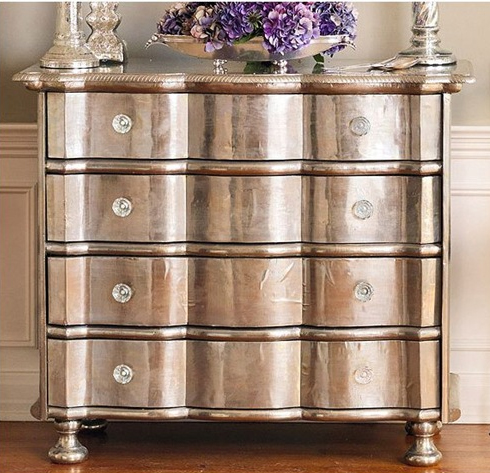
Metallic paint.


Love the country feeling...


Reminds me of New Orleans eclectic...


I love this chest of drawers by junkdrawerdivas.

Goes with this quote I found on Mona Simpson's eulogy to her brother, Steve Jobs:

 “Fashion is what seems beautiful now but looks ugly later; art can be ugly at first but it becomes beautiful later.”


Another chest of drawers by junkdrawerdivas...


Also by junkdrawerdivas...


wallpapered drawers


Visit here to see more vanities.


Red barrel-back captain's chairs.